
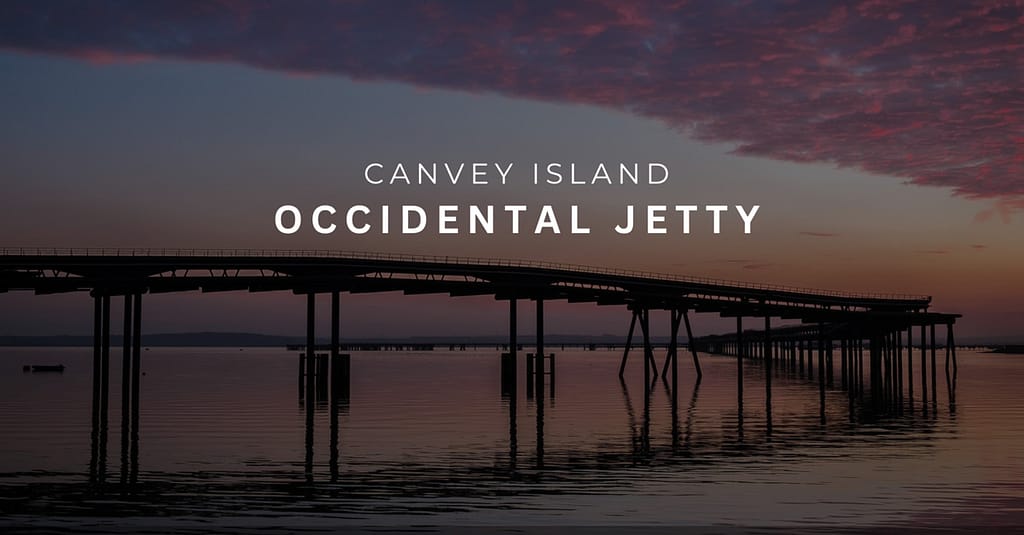
The Occidental Jetty on Canvey Island
Canvey Island in Essex is home to the fascinating Occidental Jetty, a truly unique landmark. This monster of a structure, tied to the Thames Estuary’s oil industry history, is the remnants of an ambitious industrial project and abandoned dreams.
Here’s a look at its intriguing background, engineering, and enduring significance.
Please note that this post contains affiliate links. This means that if you purchase a product through one of these links, I may receive a small commission at no extra cost to you. This helps support my blog and allows me to continue creating high-quality content.
How the Occidental Jetty Ignited My Passion
I’ve always had a profound fascination with the Occidental Jetty on Canvey Island. Even all these years later, I still find myself admiring its imposing presence whenever I drive past. It’s become my absolute go-to spot on a foggy day or when snow blankets the landscape.
The way its dominating structure emerges from the water, stark and dramatic against the backdrop, makes for a truly fabulous photo opportunity. And let me tell you, Canvey Island sunsets and sunrises are definitely a hidden gem! The times I’ve dashed over there with my camera are countless. That black silhouette of the Occidental Jetty is just… amazing.
Okay, enough of me trying to sell you on its photogenic qualities – you really need to see it for yourself! In my opinion, there’s something genuinely magical about the Occidental Jetty. In fact, I’d go so far as to say it sparked the beginning of my long and passionate journey into urban exploration photography and documenting abandoned industrial and historical sites.


Historical Background of the Occidental Jetty
The Occidental Jetty on Canvey Island was constructed in the early 1970s as an integral part of the ambitious Occidental Oil Refinery project. This massive refinery was intended to process crude oil from supertankers docking at the jetty. However, the 1973 Oil Crisis, ultimately led to the project’s abandonment, leaving the vast refinery complex incomplete.
Looking at it from above, the Occidental Jetty protrudes from the shoreline opposite Roscommon Way, extending into the Thames Estuary towards and then alongside Coryton, taking several turns to land in the perfect position for receiving the oil from supertankers in the deeper section of water.
The Occidental Jetty, often affectionately known by locals as the “Black Jetty ” was just a small, albeit significant, part of a much larger industrial complex. Remnants of this colossal undertaking can still be seen over in the Canvey Wick Nature Reserve. If you take a look on Google Maps, you can clearly trace the outline of where the gigantic oil storage tanks once stood. Whenever I cycle over there, it’s a personal tradition to do a lap of any of the tank circles before passing through – because, well, why not!?
In 1970, Occidental Refineries Limited, a subsidiary of American Occidental Petroleum Corporation, pursued building an oil refinery on a 323-acre marshland site on Canvey Island, Essex. The refinery was to process crude oil delivered via a mile-long jetty extending into the Thames Estuary.
Construction began in 1972. Workers built storage tanks, a 137-meter-high chimney, and the iconic jetty. However, the 1973-74 oil crisis halted construction in 1975, rendering the project economically unviable after a staggering £55 million investment.
In 1977, Occidental Refineries proposed adapting the refinery to produce high-octane fuels, but officials rejected the plan due to significant safety concerns. Occidental Petroleum Corporation also abandoned further plans in 1980, following the Iranian Revolution and subsequent rising global oil prices, which further sealed the project’s fate.
By 1993, CMN Enterprises of China bought the unused refinery plant. The site was cleared in 1996-97, leaving only the Occidental Jetty and scattered concrete foundations. Today, the Canvey Wick Nature Reserve protects a significant portion of the site, designated a Site of Special Scientific Interest (SSSI) in 2005 due to its unique ecology thriving on the disturbed industrial land.
Despite the massive investment, the Occidental Canvey Refinery never stored or processed any oil or petroleum.
Structure & Design of the Canvey Island Jetty
The Occidental Jetty was designed to facilitate the transfer of crude oil from tankers to the refinery. It features a remarkably long, yet robust structure extending deep into the Thames Estuary, with large pipes running alongside its length that were specifically engineered for pumping oil.
Reaching a staggering approximately 1,200 feet into the Thames Estuary, and standing approximately 80 feet tall at its highest points, the jetty truly has a massive, undeniable presence in the local area.


It was constructed using robust materials, primarily reinforced concrete and steel, specifically chosen to withstand the harsh and corrosive marine environment of the estuary for decades.
Interestingly, it was even nominated for the Design Museum’s “Lesser Known Architecture” display in 2013, highlighting its architectural significance as a prime example of industrial architecture in Essex and an intriguing piece of Canvey Island history.
CanveyIsland.org have a fabulous set of photographs from 1976 from when the oil tanks were still in situ.
Current State: The Abandoned Occidental Jetty
The Occidental Jetty on Canvey Island remains an abandoned, striking symbol of an ambitious industrial project that never fully came to fruition. Time has left it to slowly deteriorate.
Despite considerable efforts to deter visitors from climbing the structure, local fishermen historically “plot up,” urban explorers continue to document its fascinating decay, and local youngsters, naturally, its forbidden allure often draws in.


Accessing the Occidental Jetty is extremely dangerous and we strongly discourage it due to its deteriorating condition and structural instability. It also houses a very large and thriving pigeon population—they WILL make you jump! While the jetty continues to attract photographers, urban explorers, and adventurers, we crucially and repeatedly advise you not to venture onto it due to severe safety risks. Seriously, for your own safety, observe this Canvey Island landmark from the ground along the sea wall.
Where to Park for Views of the Occidental Jetty?
For the best and safest views of the Occidental Jetty, and to understand its scale, you can conveniently park at:
Lobster Smack Car Park
Location: Haven Rd, Canvey Island SS8 0NR
Cost: Free parking.
Walk to Jetty: From the car park, follow the gravel path to the right of the pub. It’s an easy and pleasant 5-10 minute walk to a fantastic vantage point for photos and to simply take in the majesty of this historical Canvey Island site.
Address: 276 Northwick Rd, Canvey Island SS8 0PT
Cost: Free parking.
Important: Remember to check closing times, as gates are locked.
Walk to Jetty: This option is perfect if you’re looking for a longer walk. You can explore the former refinery site, observe diverse wildlife (listen out for the cuckoo, we often hear it in the evening!), and then exit on the opposite side of the site to walk along the seawall directly to the jetty.
REFLECTIONS ON FAILED AMBITION
The Occidental Jetty reminds us of Canvey Island’s industrial past, offering a glimpse into ambitious, large-scale projects that once sought to shape the area.
Though not in use, its imposing presence and compelling history continue to intrigue and inspire all who learn its unique story and significance as an Essex landmark.
Nature is slowly reclaiming its land, the weather & Thames Estuary constantly battering the jetty, and even in the nature reserve, many of the concrete structures are hidden from sight, where plants are reclaiming their land.
I often wonder how many eyes fall upon this structure, utterly oblivious to its history, and how different this land would have been if there had been a different turn of events in history.
So, next time you find yourself on Canvey Island, take a moment to gaze upon the Occidental Jetty. Its unfulfilled dreams and haunting structure remind us of its failure.